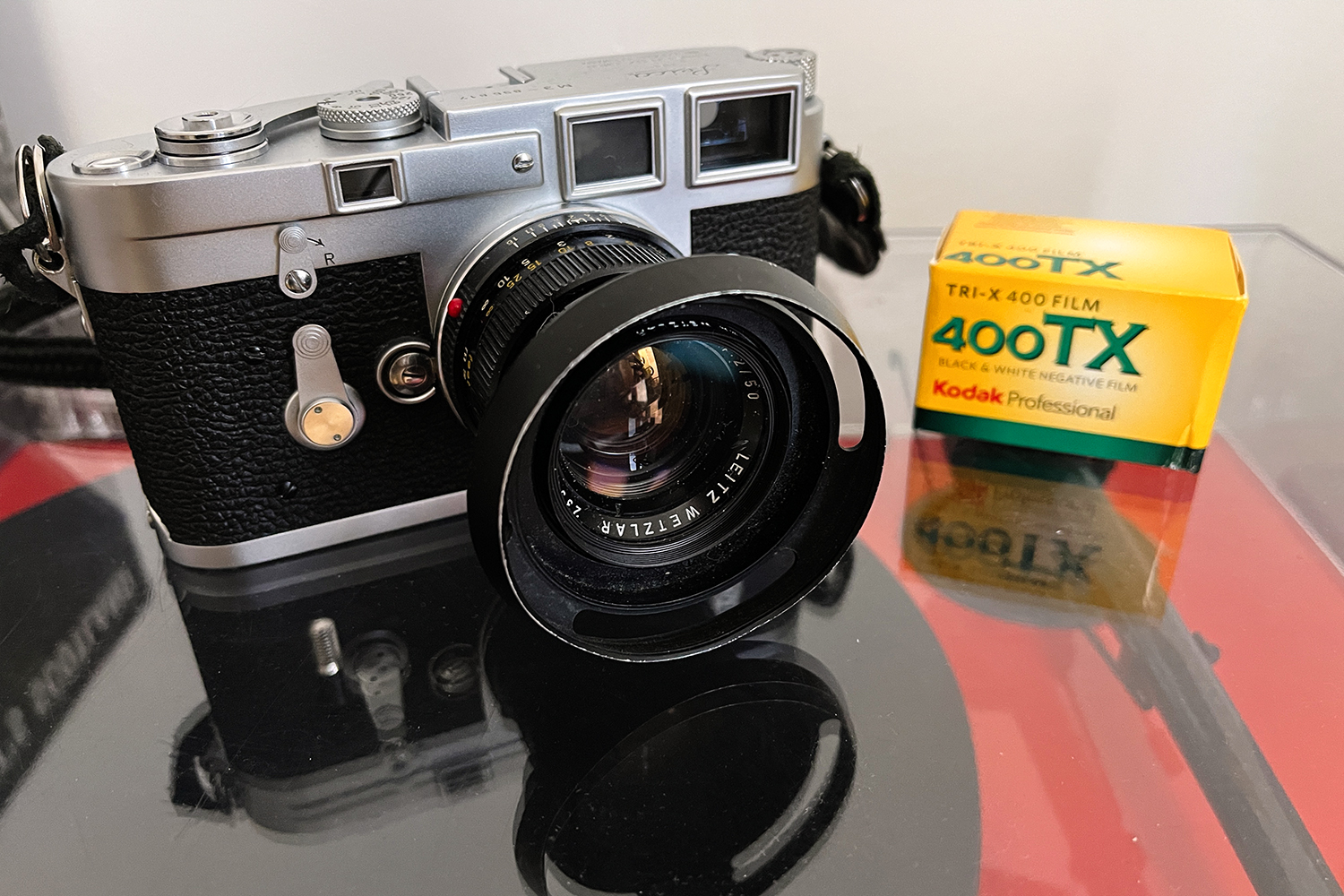
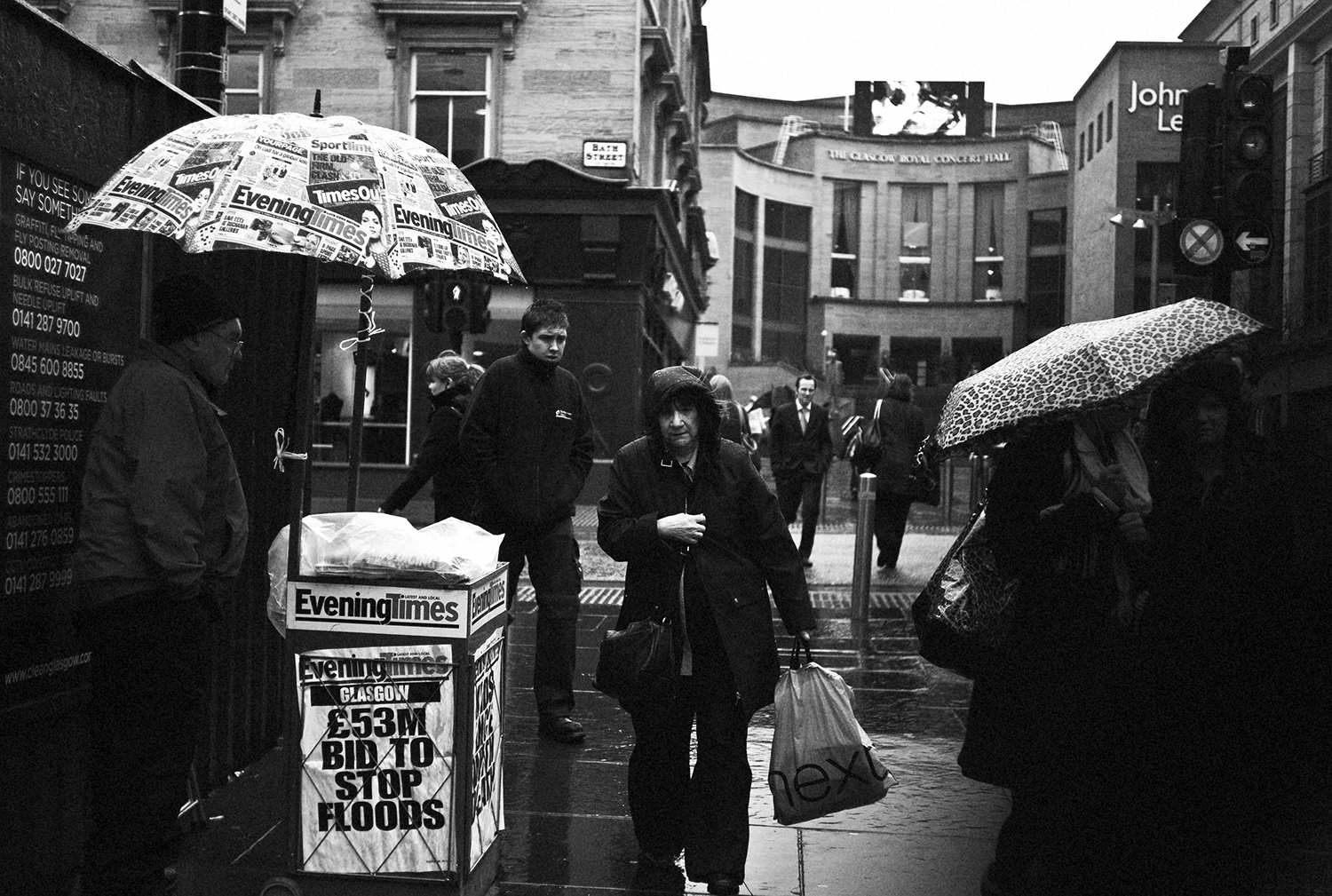
In the cold winter of 2021, a singular moment of stupidity as I changed a roll of film caused my Leica M6 to drop from my hand and bounce on the concrete. Its storied life flashed before my panicked eyes.
Lifting it from the floor, time slowed, and I felt a figurative, if expensive, bullet graze my shoulder. The mangled plastic rewind mechanism pointed towards the long repair that lay ahead of us.
I had no immediate plan to buy a second Leica M body, though I was saving for one. The temporary loss of the M6, combined with the fortunate proximity to my birthday, provided a gossamer-thin layer of cover needed to justify the exciting purchase of my now precious Leica M3.
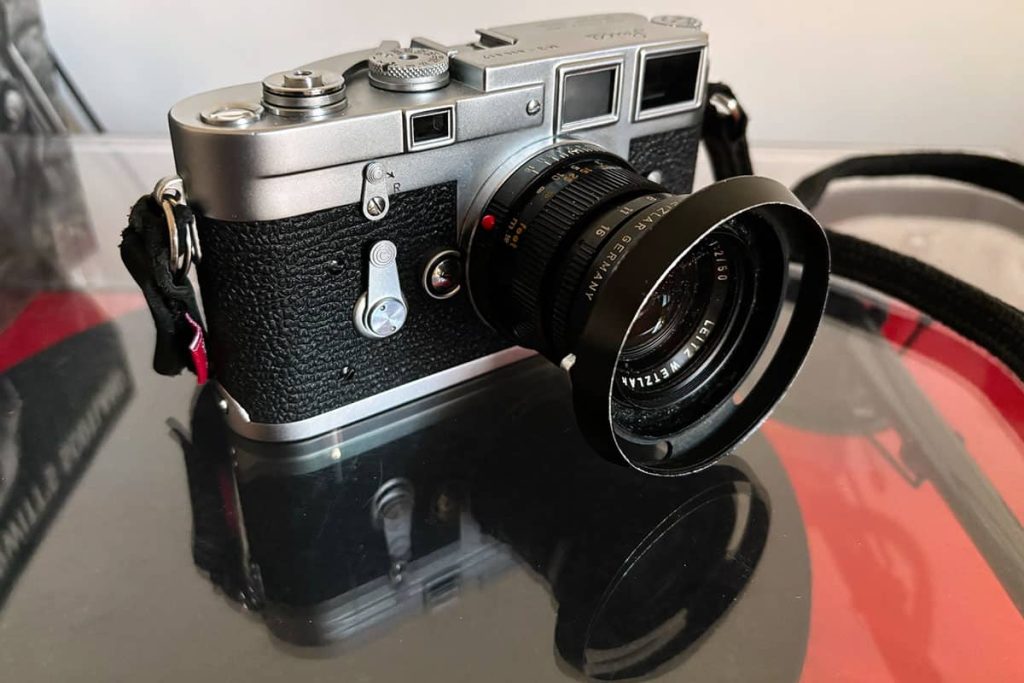
The History of the Leica M3
Launched in 1954, the Leica M3 sold over 226,000 units before it was discontinued and replaced by the M4 in 1967.
Despite its name, the M3 was the first Leica M series camera to be introduced following a redesign of Oskar Barnack’s popular screw-mount Leica cameras. Taking its letter designation from the word Messsucher – the German for Rangefinder – the Leica M3 was so named for the rangefinder focusing mechanism, and a choice of three sets of frame lines was viewed through its single bright viewfinder window.
Additional innovations further set the new Leica M3 apart from its predecessors. For convenience, the wind-on dial was replaced with a thumb lever advance, and the solid shell of the screw-mount models was replaced with a hinged back, which eased and quickened the changing of film.
The camera remained entirely mechanical, although technology permitted minor automatic and electronic action within the new design.
Convenience
The most convenient redesign, however, was the top plate. Unlike the Barnack models, the shutter speed could now be chosen from a single dial. All controls on the new M were found across the top plate and could be read at ease from above.

Building on this novel convenience, the operation was significantly improved. Across all areas of the model, from shutter release to film advance and film rewind, the camera is oh-so quiet.
Though in this review lenses will be set aside, as one would expect from a Leica, the optics of the Summicron 50mm f2, with which it shipped, are perfect. Replacing the M39 Screw Mount for swift and nimble lens replacement, the M3 has a bayonet system appropriately dubbed the M Mount.
That this revolutionary design has remained consistent, with few changes or additions, for almost 70 years, is a testament to the timeless excellence of the original Leica M.
Leica M3 Build Quality
To some extent, build quality is a subjective matter of opinion. One person’s robust, solid camera body is another’s leaden paperweight. For me, build quality is directly proportional to the camera’s life expectancy, and, as is obvious from my camera being only a few years younger than my parents, the Leica M3 lasts, partly due to its sturdy construction and precise operation.
Used every day, an M3 should last a decade without the need for cleaning, lubricating, and adjusting (CLA), and, if kept well, will still look just as good as it did new.
What makes the Leica M3 a tough, robust camera is that its metal body, specifically brass, is strong and resistant to corrosion. The top and bottom plates are brass-plated in chrome for a clean, bright, and distinctive sheen. The covering stretched around the camera is vulcanite, and though intended for grip, it has given the camera a now-classic aesthetic.

Light Enough For a Day on the Street
In comparison to most professional SLR cameras, the Leica M3 can’t be described as a heavy camera, however, it does have some heft to it. Place it in the hands of someone unsuspecting, and there will be a surprise at its weight.
Of course, were it too heavy, it would not have become the acclaimed and sought-after camera it did. It is light enough to carry all day and not get tired. Containing a roll of Kodak Tri-X, my M3 weighs 622g, and with the Summicron 50mm f2 lens attached, it is not much less than a kilogram, weighing 844g.
Light enough for a companion all day out on the street, and heavy enough that it will be missed if left behind, or worse.
The Leica M3, while in its 69th year, has not yet been bettered for simplicity or reliability. The internal workings of the camera are mechanical. With the exception of the gold sync contacts for flash bulbs and electronic flash, there are no electronics on board, and there is no battery required.
A conversation with an acquaintance at Leica in London described the shutter speed timing mechanism within the M3 as akin to a Swiss clock. Exacting pinpoint precision at all costs. It is a light-tight box with a timed shutter, and yet, it is so much more.
Let’s take a closer look.
The Top of the Leica M3
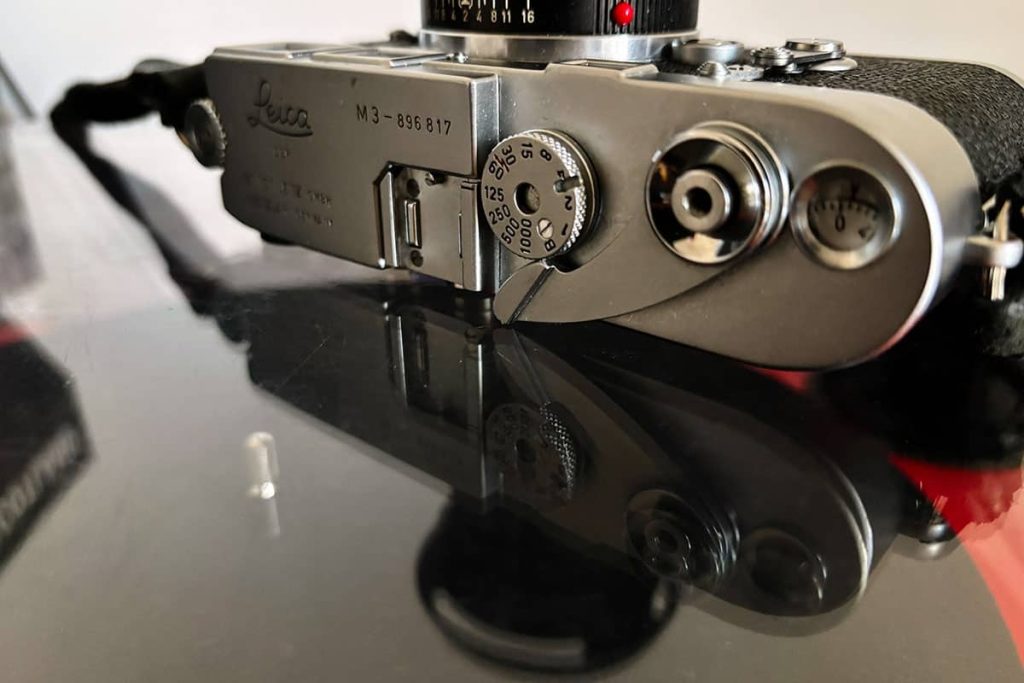
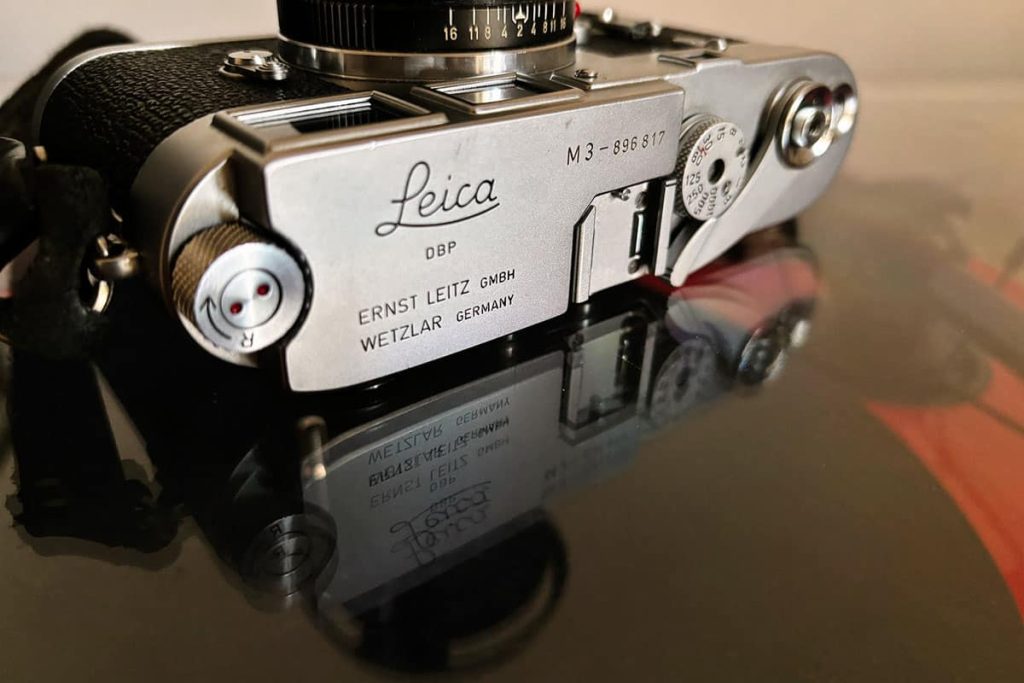
Like that of the Leica M4 that succeeded it, the chrome-plated brass top plate of the Leica M3 is iconic.
The beautiful, precise engraving of the Leica script sits above the Ernst Leitz Wetzlar imprint. Simple, unassuming, and yet elegant and timeless.
Though one may argue it is not as instantly recognisable as the famed red dot, with its top-plate branding, the Leica M3 is less likely to distract or catch a subject’s eye while shooting in the street.
To the right of the Leica script, placed just above the hot shoe, is engraved both the model and the serial number.
Shutter Dial and Shutter Release
Unlike the screw-mount cameras that came before, the Leica M3 combines both long and short shutter speeds onto the same dial for a single, unified, and quicker selection. The shutter speed dial is a robust, solid circular piece of metal that is difficult to nudge accidentally and would take Peter Gabriel’s titular sledgehammer to break.
The ridges cut into the dial mechanism both catch the dial, firm in each setting, and give haptic reassurance to the photographer with its ever-so-satisfying click into place.
There is a small, oblong channel cut into the top of the dial between the 1/2s and 1/4s settings. That this had some purpose was only made clear when I bought a Leica MR light meter, which attaches to the top of the camera.
From the bottom of the meter, a pin slides into the channel, and, as the shutter speed is selected on the meter’s control, the pin controls the dial on the camera.
A more modest Range
Though modern digital Leicas have a range of electronically-assisted shutter speeds from an hour through to 1/4000th of a second, the mechanical M3 has a more modest range from 1s to 1/1000s.
There is a Flash-sync setting set at 1/50th of a second, and, should you need a longer shutter speed than 1 second, there is a Bulb setting for manual control.
All speeds are marked in black against the chrome metal of the dial and, when not in darkness, can be seen with ease – even with eyesight as poor as mine.
From the shutter speed, one only needs a short 2 cm journey to the right to find the shutter release set within a ring that sits above the advance lever.
As with all but the limited flash function, the shutter release is mechanical and has no electronic support. There is no half-press for focus or to activate a light meter, only a simple, smooth, steady depression of the button to hear the pleasing ssnnk of the horizontal, cloth shutter curtain travel across the frame.
Film Winder and Counter
On the older Barnack models, when the photograph had been made, there was an arduous dial to turn and wind the film on. All manner of contortions were needed to quickly set the camera for another frame. Replacing this is a thumb-controlled advance lever.
In earlier models like mine, the advance used a double-stroke mechanism. The first to cock the shutter, and the second to advance the film.
In later models, this was replaced with a single-stroke action with both functions occurring across a single draw of the thumb.
As the film advances, look across to the left at the rewind knob. It’s comforting to see the film is advancing inside the camera by observing the small pair of dots that revolve as the lever is pushed.
Double-Stroke
Many Leica M3 users advocate a double-stroke lever; others a single-stroke. From all the information I could find, it seems to be a subjective preference. I have it on good authority, though, that if a double-stroke mechanism requires repair, Leica will instead replace it with a single-stroke advance, so if you like the DS, don’t break it.
Single or double stroke, the wind of an M3 advance is smooth, and, as it is made of solid metal rather than the plastic-tipped controls of later cameras, there’s little chance of breaking the lever.
As the film is wound on, the inexorable frame counter ticks forward. Found on the farthest right of the top of the camera, the counter is housed in a subtle dome of glass.
Though there are 44 frames marked on the counter, the mechanism stops turning at 40; two of the additional four are cosmetic and complete the circle back to 0.
Unlike earlier Leicas, the camera effects an automatic reset when the take-up spool is removed, flipping the counter back to -2, to allow for two wind-on shots before the counter returns to 0.
Rewind Knob
On the opposite flank of the top plate rests the rewind knob. If there is one criticism a modern photographer may levy at the Leica M3, it is that rewinding the film takes an interminable time – especially when compared to the speed of winding back an M6.
To rewind the film on an M3, one flips the lever on the front of the camera towards the letter R, lifts the knob out from the central advance indicator, and twists. Relentlessly. Twist until the knob resists and the film is pulled off the take-up spool.
Between 20 and 30 seconds can be spent twisting and turning the knob before even beginning to load a new roll.
While I’ve heard tales of a Leica-produced crank tool that can be fitted around the knob to make rewinding quicker, I’ve never seen one or known anyone to use one.

Leica M3 Rangefinder mechanism
The Leica M3 is, of course, a rangefinder camera, and, thus, focus is found via the rangefinder mechanism built into the body.
For the unfamiliar, to focus using a rangefinder, the photographer looks through a viewfinder in the middle of which is a second small, illuminated rectangle. As the focus ring is turned, the picture in the smaller rectangle moves left or right. The goal is to match that of the diminutive rectangle with the image in the larger window. As the lines superimpose, the focal plane has been found.
Earlier Barnack Leicas separated the viewfinder and the rangefinder. The photographer peered through one window to focus using the rangefinder system and then moved their eye to the window beside it to compose the frame.
On the Leica M3, the separated windows have been combined for the convenience of the photographer. It makes all the difference.
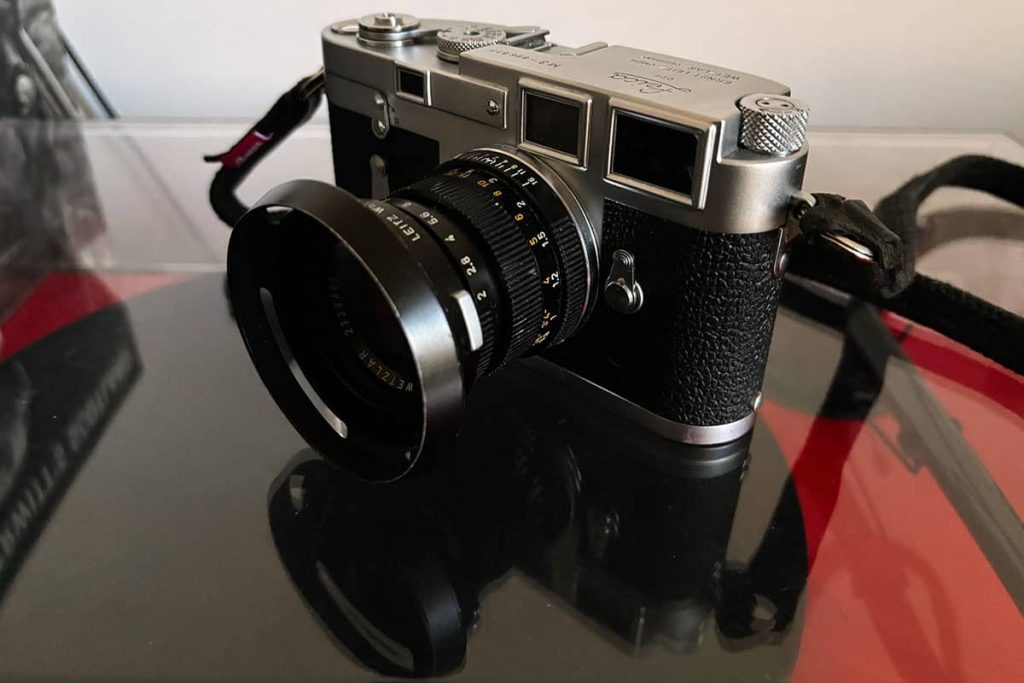
On the front of the camera can be seen the three rangefinder windows. When facing the camera, on the right, there is the unified viewfinder. To its left, there is the bright line illumination window. This gathers the ambient light to illuminate the frame lines within the viewfinder. Further to the left is the rangefinder window, which provides the image in the small, central rectangle used to focus.
Effective Base Length
The accuracy of the focusing system within a rangefinder is dependent on what is known as the Effective Base Length (EBL). The higher the EBL, the more accurate the focusing. The lower, the less accurate.
The EBL is calculated by multiplying the base length of the rangefinder by the magnification of the viewfinder. The base length is the distance between the viewfinder and the rangefinder window.
Leica M3s have the same base length as other Leica M series cameras; however, as the magnification of the viewfinder is higher, the effective base length is more accurate.
The Leica M3 has a viewfinder magnification of 0.91x, which is close to a 1:1 ratio of magnification. For comparison, the Leica M6 viewfinder has a magnification of 0.72x.
The base length of the M6 is 69.25mm x 0.72 magnification, which gives an EBL of 50mm. The base length of the M3 is 69.25mm x 0.91 magnification, which gives an EBL of 63mm.
While such things are marginal, the larger EBL on the Leica M3 makes the camera more reliable to focus, particularly when using longer lenses wide open, where every millimeter counts.
Though one can cheat closer in various inventive ways, the M3 is rated to focus from as close as one meter, all the way out to infinity. While the camera does have automatic parallax correction, it is wise to keep it in mind when shooting near the subject.

Frame lines
Setting the rangefinder mechanism aside, then, let’s look through the viewfinder itself and those bright, beautiful, welcoming frame lines.
One of the big attractions of a rangefinder camera, particularly the older Leicas, is the lack of distraction in the viewfinder. There are no flashing lights, nor levels, grids, or gauges. There is a single set of frame lines and the rangefinder rectangle. That’s it.
The frame lines available are limited. Newer Leicas have a selection of six. The M3 provides only three. The 50mm lines are always on, and either the 90mm or 135mm lines will appear if an appropriate lens is attached.
The frame lines can be previewed without changing the lens by using the lever on the front of the camera.
With such viewfinder magnification, there’s no latitude to provide frame lines for 35mm or wider focal lengths. Should one need these, an external viewfinder is required. Mind you, if an external viewfinder was good enough for Winogrand on his trusty M4, it’s good enough for any of us.

Leica M3’s Baseplate and Tripod Mount
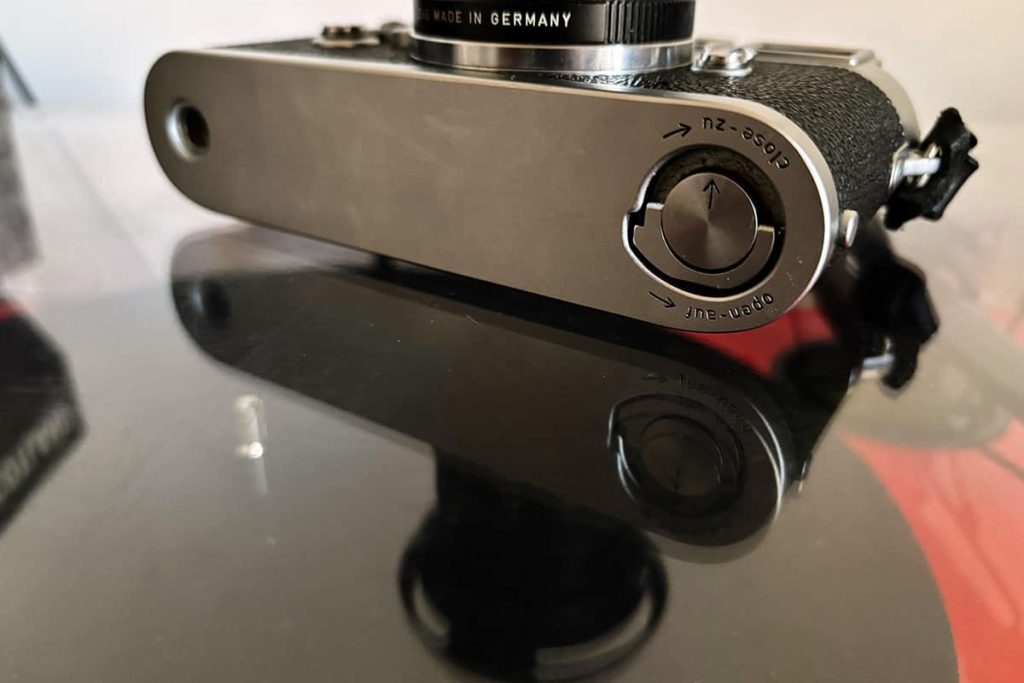
Unlike the majority of film cameras, the Leica M3 opens with a hinged backplate that swings vertically. The backplate is held in place with a brass baseplate that attaches to the body via a small jut on the right-hand side and is locked by a circular latch on the bottom.
There is little to the bottom of the camera until the baseplate is removed, save for the tripod mount. On Leica M3s sold in America, the thread of the tripod mount is measured at 1/8″, while those sold in Europe have a 3/8″ thread.
However, the most confounding thing for new M photographers is that the mount is not centred, sitting instead on the right-hand side of the camera. This can look and feel odd when used, but photographers have been mounting their M3s on tripods for almost 70 years now with little to complain about. It only takes a little getting used to.
Loading the Leica M3
Once the baseplate is removed, the hinged back can be swung up to view the film path in front of the shutter curtain, and it is in the absence of the baseplate that the bottom of the camera becomes somewhat more illustrative.
On the left, there is the cavity for the film roll, and on the right, there is the removable take-up spool.
In comparison with modern analogue Leica M cameras, the M3 is more time-consuming to load. One needs to remove the take-up spool, find the small clip to slide the film underneath, and then load the roll and take-up spool into the camera, ensuring the film is seated correctly in the transport path and on the wind-on cogs.
Much easier than the Leica III series to be sure, but requires some concentration, particularly when loading in the dark or on the move.
With time comes practice and with practice comes ease – especially if using the Winogrand flip. When changing rolls on his Leica M4, hung around his neck, Garry Winogrand would flip the camera upside down, so the bottom was facing him as he looked down onto it, and the lens rested against his body, making removal of the rewound film and replacing it with a new roll a little easier.
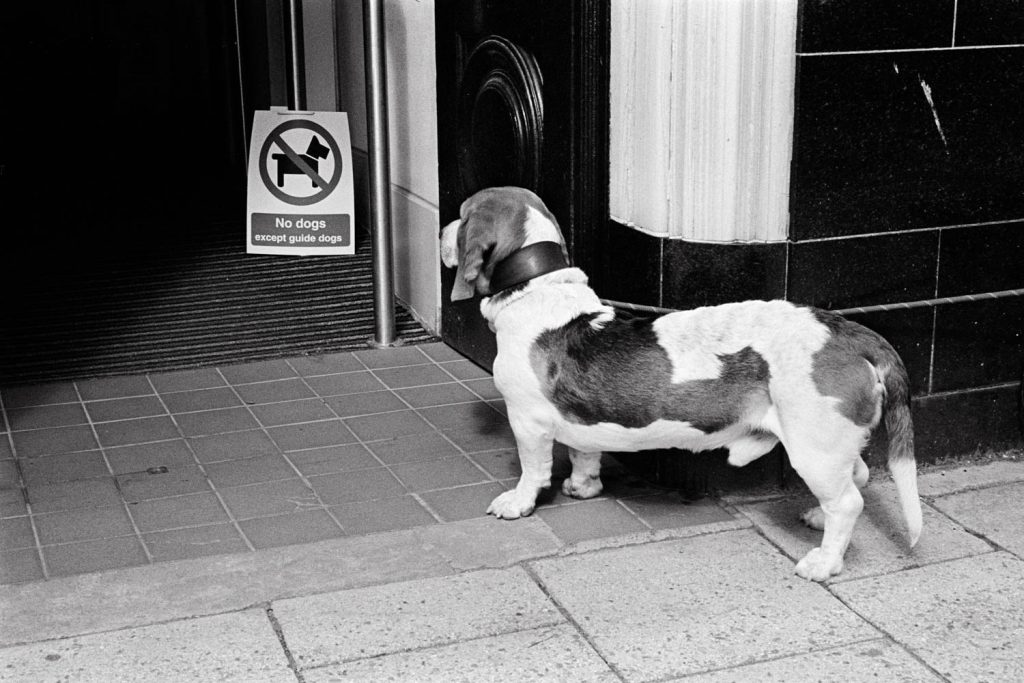
Mind you, Winogrand would temporarily put the bottom plate in his shirt pocket. I take my cue from our dog, and mine ends up in my mouth.
On the Back of the Leica M3
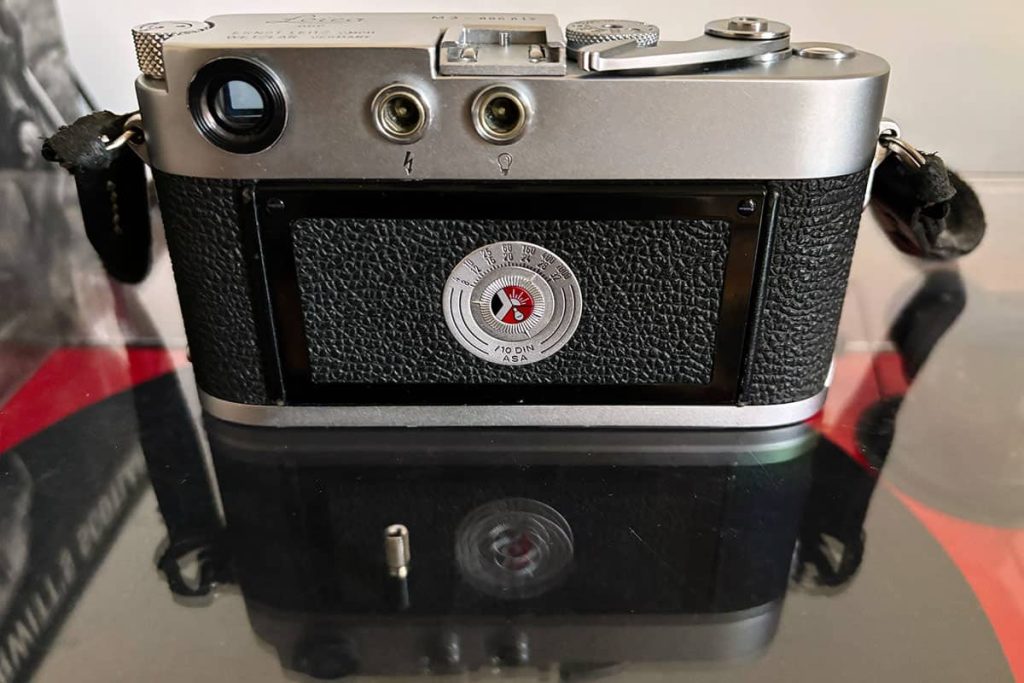
In keeping with the sleek, minimal aesthetic of the Leica M3, the hinged backplate is home to only the ISO and film-type reminder, a small spring-loaded dial to be turned to indicate when using either a black and white, tungsten, or daylight film – and the corresponding ISO.
Above the backplate, set into the chrome-plated brass of the body are two small plugs – the rear flash sync terminals, two plugs I’ve never had cause nor facility to use. Both terminals require an outmoded, proprietary Leica-devised connection to fit, and while there is a combination of different adapters that will get it there, your flash also needs to have the PC connector at the other end.
For a flash with a sync speed of 1/50s, I’m not sure it’s worth the effort, but it’s there should it be necessary.
The terminal with the symbol of the bulb is for the old ignitable glass flash bulbs. The terminal with the lightning bolt symbol is for xenon electronic flashes, so any semi-modern flash you may want to use. The difference between them is timing. The former is triggered a fraction earlier than the shutter, as the old glass bulbs were slow to ignite.
A Lifetime Investment
Advertised by Leica as a lifetime investment in perfect photography, the Leica M3 became as famous as its photographers, who, in their number, included Cartier-Bresson, Capa, Frank, Erwitt, Winogrand, and far too many others to mention.
It is a camera prized for its precision engineering, robust build, and beautiful design. It is by far and away the most enjoyable film camera I have used, and I expect to use it for many years to come.

This slightly-edited article was originally published on Shoot It With Film on January 12th, 2024.